Building a Business on Reliability — and Finding an Insurance Partner Who Does the Same
How the Camille Bunicci Agency Helps Owner Jay Hansen Protect His Business… Without Letting Insurance Get in the Way of Running It
For Jay Hansen, owner of Innovative Glass & Plexiglass, success has always come down to something remarkably simple: Do what you say you’re going to do.
Jay started Innovative Glass nine years ago after working in the hardware industry and repeatedly hearing the same frustrations from homeowners. “Day after day, homeowners were coming in telling me that contractors don’t show up or don’t do what they said they were going to do,” Jay says. “At the same time, contractors would come into the store complaining that business was slow.”
Jay saw an opportunity. “I said, well, I could fix this,” he says. “It’s very simple — just show up on time, and do what you said you were going to do.” That straightforward philosophy became the foundation of Innovative Glass & Plexiglass. And years later, it also helps explain why Jay values his relationship with the Camille Bunicci Insurance Agency.
Building a Reputation, One Customer at a Time
Innovative Glass wasn’t built through aggressive expansion. It was built through reliability. In the early years, Jay used services such as HomeAdvisor and Angie’s List to get the company’s name in front of potential customers. But as the business established itself, referrals became increasingly important. “It was a slow road building my business on that premise… not just trying to grab money and run. But it worked, and now it’s paying back tenfold. I have loyal customers,” Jay says.
More importantly, those customers are comfortable putting their own names behind the recommendation. “They’re able to refer me out to anybody comfortably, because they know I’m going to show up and do exactly what I said I was going to do,” he says.
Jay has intentionally kept the company relatively small as well. After speaking with other contractors who grew dramatically (only to see their expenses and labor issues grow exponentially alongside their revenue), he decided that bigger wasn’t automatically better. His priority is maintaining a manageable operation, controlling expenses and ensuring that work carrying the Innovative Glass name meets his own exacting standards.
Insurance Needs That Go Beyond a Typical Service Business
The day-to-day realities of a glass company create risks that aren’t necessarily obvious from the outside. Jay operates a Chevy 3500 extended van equipped with a large exterior rack system designed to transport glass. That glass can be extremely valuable. “You’re traveling with a $2,000-to-$3,000 shower door on the side of the truck, and you’ve driving down the Long Island Expressway. The rocks are constantly flying from the gravel on the side of the road… it’s a little hair-raising,” Jay says. Even with specialized equipment designed to protect the glass from wind and road debris, accidents can happen.
Jay recalls one incident where the truck itself wasn’t struck, but the exterior glass rack was. “It was parked, and a tractor trailer hit the glass rack,” he says. “It missed my truck, but the glass rack sticks out. So the good news is that the collision missed the truck… but the bad news is that it it hit the glass rack and completely destroyed the door.” Inevitable situations like that reinforce how important it is to make sure the business — and its specialized equipment — are properly insured.
Transportation Isn’t the Only Risk
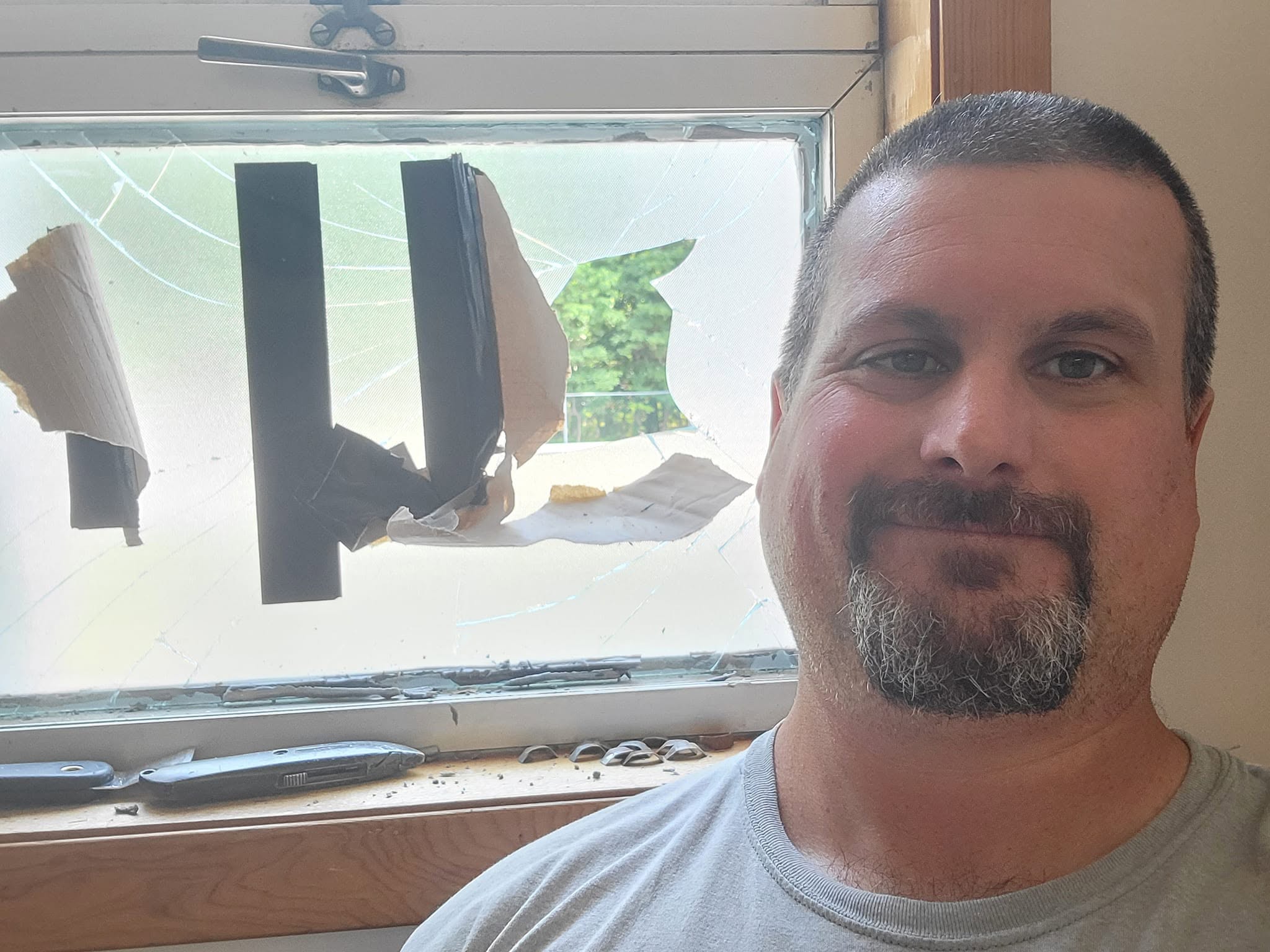
Innovative Glass also performs emergency work, including responding to businesses after break-ins or other incidents involving shattered storefront glass. These aren’t always neat, controlled installations during normal business hours. Sometimes Jay is arriving late at night to a location with large pieces of broken glass still hanging overhead. “Honestly, I do a dangerous job,” Jay says. “You know, the storefront gets hit by a car, is broken into, the glass is broken, and it’s large pieces of glass, broken, hanging from the ceiling.” That means Jay needs to know he and anyone he brings onto a job are properly protected. And that’s exactly the kind of detail that Camille and her team took the time to understand.
From “Just Another Number” to a Real Insurance Conversation
Jay met Camille through their mutual volunteer work with the Rotary Club. At the time, he already had business insurance. What he didn’t have was confidence in the relationship behind it. “My insurance guy, I was just another number,” Jay says. “He didn’t care… he just gave me a policy, whatever one. I didn’t even read it.”
As Innovative Glass became more established, Jay realized that simply having a policy wasn’t enough. He wanted to know that his business was actually protected appropriately. “I really need to make sure I’m covered. I need to have a real conversation with someone,” Jay says of his thinking at the time. That conversation happened with Camille. And from Jay’s perspective, her approach was immediately different.
Rather than simply quoting another policy, Camille started asking questions about how Innovative Glass actually operated. What did Jay do during a typical day? What kind of work was he performing? What equipment was he using? Where could problems arise? “I sat down with Camille, and she started going over, ‘Well, what do you do in a day, and what do you really need?’” Jay says. “Going through everything, it was a whole different experience.”
For Jay, that difference mattered. Camille wasn’t treating Innovative Glass as a category on an application. She was trying to understand the business behind the policy.
“Can You Take Care of That?” — And She Does
Today, Jay’s confidence in the Camille Bunicci Agency has reached the point where insurance is something he is comfortable handing off entirely. When an insurance-related issue comes up, he doesn’t feel the need to act as the expert himself. He simply calls Camille and her team. “I have such trust in Camille at this point,” Jay says. “I go, ‘Oh, Camille, that’s an insurance thing. Can you take care of that?’ And she just does it, and it’s done, and it takes it off my plate. For a business owner, that’s a meaningful benefit.”
Jay already has customers to take care of, glass to install, a commercial vehicle to operate and emergency calls that can come in at any hour. He doesn’t want insurance to become another job. “I never think about insurance… ever,” Jay says. And in his view, that’s exactly how the relationship should work.
Being Proactive Before Something Goes Wrong
Jay especially appreciates that Camille doesn’t wait for him to identify an insurance issue. She stays ahead of it. “It’s more of a proactive approach on her part,” Jay says. “She calls me up and says, ‘Hey, we need to adjust this, do this and get it done right now.’” That proactive communication helps make sure changing circumstances are addressed before they become a problem.
For Jay, it means one less major responsibility competing for his attention. “Eliminating having to think about insurance allows me to work on my business and not waste time,” he says. That peace of mind becomes especially important when he’s responding to one of the more hazardous jobs Innovative Glass encounters. “Camille takes care of it, so it’s just one less thing to worry about,” Jay says. “It definitely puts me at ease when I have to go in the middle of the night and take care of some dangerous stuff.”
A Referral From Someone Who Built His Business on Referrals
Perhaps the strongest endorsement comes from the way Jay talks about Camille to other business owners. Innovative Glass itself has grown through the trust of customers willing to recommend Jay to someone else. So he understands what it means to put your reputation behind a referral. And when Jay hears another business owner complain that their insurance broker wasn’t responsive or didn’t have them covered properly, he doesn’t hesitate. “You’re at the wrong place, man,” Jay says he tells them. “Switch over. Here’s the person. She’s going to take care of you. It’s going to be done. It’s going to make your life easy.”
Asked whether he refers Camille, Jay’s answer is immediate: “Absolutely. Absolutely all the time.” For Jay, that’s the ultimate expression of confidence.
Is Insurance Keeping Up With YOUR Business?
If you own a Long Island business and aren’t sure whether your current insurance program truly reflects the way your company operates, start a conversation with Camille Bunicci and the team. We’ll take the time to learn about your business, understand the risks you face and help you make informed decisions about protecting what you’ve built.